
Cursive writing practice does not have to mean filling page after page of letters. Fun cursive writing activities for kids can turn handwriting practice into games, creative projects, and little challenges. Children can practise letter formation, connecting letters, spacing, words, and sentences while they are having fun.
A simple scavenger hunt can turn into cursive word practice. A secret message can help a child focus on readable handwriting. Even a tray of sand can become a place to practise difficult letters. The key is to choose activities that match your child’s skill level and give them a reason to write.
Table of Contents
How to Make Cursive Practice Fun for Kids
Children usually enjoy handwriting more when they have something interesting to do with it. Instead of asking your child to write the same letter twenty times, give the practice a small purpose.
Keep activities short and focus on one skill at a time. A child who is learning letter formation might practise a few letters through a tracing game. A child who already knows the alphabet can move on to words, messages, and short stories.
You can also let your child choose the colours, words, or theme. If they love animals, use animal names. If they like treasure hunts, turn handwriting practice into clues. The writing still gets done, but it feels more like play.
10 Fun Cursive Writing Activities for Kids
1. Rainbow Cursive Letters
Rainbow writing is a simple way to practise cursive letters without making the activity feel repetitive.
Choose one letter, such as a, c, e, l, or m. Write it clearly on a piece of paper. Your child traces over the letter several times using different colours.
For example, the first a can be blue, the second yellow, and the third green. After a few rounds, ask your child to write the letter once without tracing.
What it practises: Letter formation, pencil control, and consistent size.
You can use the cursive alphabet for letter examples when your child needs a model to follow. The site provides uppercase and lowercase cursive letters for guided practice.
Make it harder: Choose a letter your child finds difficult and ask them to write it in three different words.
For example:
r → rain → rabbit → rainbow
2. Cursive Scavenger Hunt
Turn handwriting into a small search game around the house.
Give your child five things to find, such as a book, cup, pencil, toy, and bag. Once they find each item, they write its name in cursive.
You can make the game more exciting by giving clues:
Find something you use for drawing.
The child finds a pencil and writes pencil in cursive.
What it practises: Word formation, spelling, and applying cursive to everyday words.
Make it harder: Give your child one starting letter instead of an object. If you choose B, they can find or think of five things that begin with B and write their names.
3. Write Secret Cursive Messages
Kids love having a message that only someone else needs to read. Use that idea to practise neat cursive.
Ask your child to write a short message for a parent, brother, sister, or friend.
They might write:
You are my best friend.
or
Look under the blue pillow.
The other person then reads the message.
This gives the child a reason to make the handwriting clear. They need to think about letter shapes, word spacing, and readability because someone else has to understand the message.
What it practises: Legibility, spacing, and complete word formation.
Make it harder: Ask your child to write a three-sentence secret note without showing it to anyone first.
4. Sand, Salt, or Rice Writing
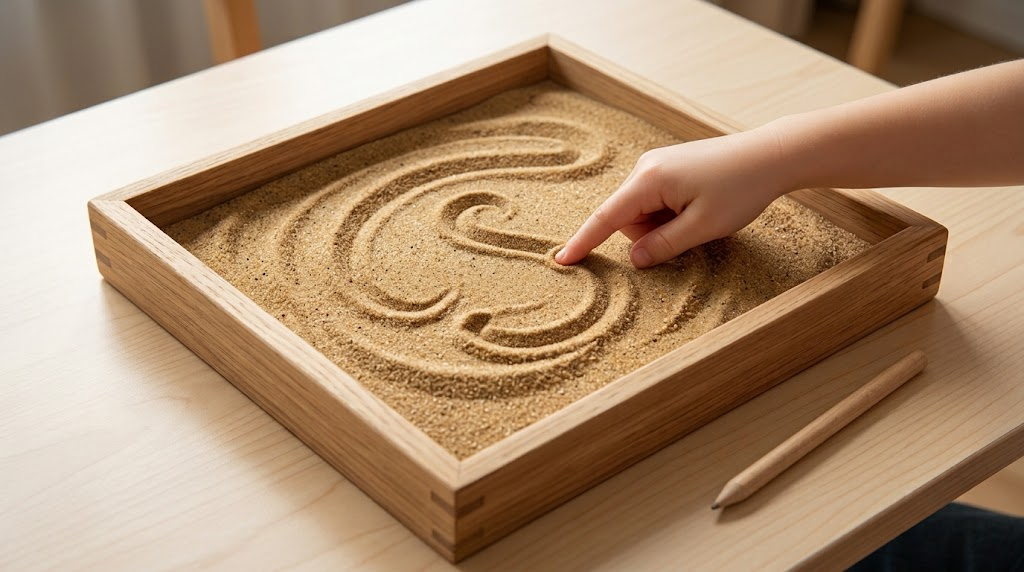
You do not always need a pencil for cursive practice.
Pour a thin layer of sand, salt, or uncooked rice into a shallow tray. Your child can use one finger to form cursive letters across the surface.
Start with simple movements. Try:
c c c c
Then move to:
a a a a
After that, combine letters:
ca → cat
The large finger movements can make letter shapes easier to notice before your child returns to pencil and paper.
What it practises: Stroke direction, letter formation, and movement control.
Make it harder: Let your child look at a cursive letter once, hide the model, and then form it in the tray from memory.
After the activity, have them write the same letters on paper.
5. Cursive Word Race
A little friendly competition can make word practice much more exciting.
Choose a category such as:
- Animals
- Foods
- Colours
- Sports
- School items
- Things at home
Give your child one minute to write as many words from that category as they can in cursive.
For an animal round, they might write:
cat, dog, rabbit, tiger, horse
The goal is not simply to write as many words as possible. Readable cursive still matters. If rushing makes the letters difficult to read, slow down and focus on clear writing.
What it practises: Word formation, writing fluency, and handwriting control.
Make it harder: Give your child a starting letter. For example, choose S and ask them to write five animal names beginning with S.
6. Build-a-Word Cursive Game
This activity helps children move from individual letters to connected words.
Write individual letters on small pieces of paper or cards. Give your child a few cards and ask them to build a word.
For example:
c + a + t = cat
Once the word is built, your child writes the complete word in cursive.
Try simple words first:
cat, sun, pen, dog, fish
Then introduce words with useful letter combinations such as:
and, tree, little, friend, school
What it practises: Letter connections, spelling, and word formation.
Children who are ready to work on joins can practise common combinations such as an, in, on, at, and st. Your cursive joining letters resources can provide additional examples and guided practice.
Make it harder: Give your child three cards and ask them to create a word using all three letters.
7. Cursive Name Art
A child’s own name can be one of the most motivating things to practise.
Write the child’s name in large cursive letters. Let them trace it, copy it, and then write it independently. Once they are comfortable, turn the name into a small art project.
They can:
- Add stars around the name
- Draw flowers or clouds
- Use different colours for each letter
- Circle letters that appear more than once
- Decorate the first letter
For example, a child named Mia can practise the same three letters several times while creating a colourful name card.
What it practises: Letter formation, repeated practice, and confidence.
Make it harder: Move from their own name to the names of family members, friends, or pets.
8. Cursive Story Chain
Cursive becomes much more meaningful when children use it to tell their own stories.
Start with a sentence such as:
I opened the door and saw…
Your child finishes the sentence in cursive.
Maybe they write:
I opened the door and saw a tiny dragon.
Then continue the story:
The dragon was holding…
You can take turns adding one sentence each.
Younger children can write one sentence at a time. Children who are comfortable with cursive can build a short story of several sentences.
What it practises: Sentence writing, spacing, punctuation, and writing fluency.
When your child is ready for more sentence practice, you can use these cursive sentences as additional guided practice.
Make it harder: Give your child three words that must appear in the story.
For example:
dragon + garden + treasure
9. Cursive Treasure Map
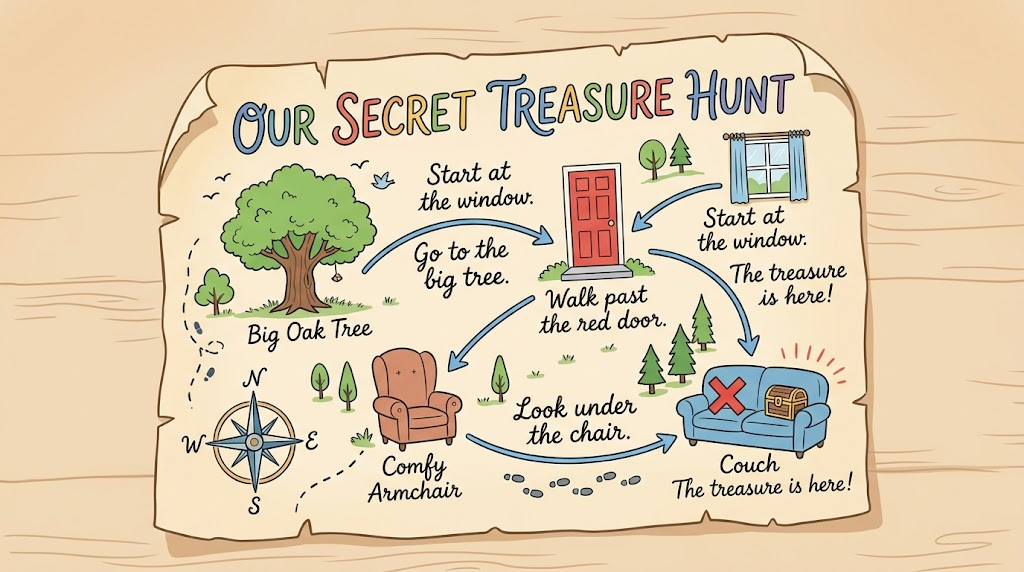
Turn handwriting practice into an adventure.
Ask your child to draw a simple treasure map. Then let them write clues in cursive.
For example:
Go to the big tree.
Walk past the red door.
Look under the chair.
The child can draw arrows, add landmarks, and write each instruction in cursive.
This activity gives children a real reason to practise words, sentences, spacing, and readable handwriting. They need other people to understand the clues, so neat writing becomes part of the game.
What it practises: Words, sentences, spacing, and practical handwriting.
Make it harder: Ask your child to write five clues that lead another person to a hidden toy.
10. Cursive Bingo
Cursive Bingo works well for children who enjoy games.
Make a simple bingo card with cursive letters or words.
For beginners, use individual letters:
a | b | c | d
For children who already know their letters, use words:
apple | school | friend | garden
Call out a letter or word. Your child finds it on the card and writes it in cursive before marking the square.
You can also make the game about difficult letter connections. Add words containing combinations such as:
th, st, ch, sh, er
What it practices: Letter recognition, memory, word formation, and cursive writing.
Make it harder: Instead of calling out the exact word, give a clue.
For example:
I am thinking of something you use to write.
The child finds a pencil and writes it before marking the square.
Which Cursive Activity Should Your Child Try First?
The best activity depends on what your child needs to practise. You do not have to start with the hardest game. Pick one activity that matches the current skill and move forward gradually.
| If your child needs practice with… | Try this activity |
| Letter formation | Rainbow Cursive Letters |
| Pencil control | Sand, Salt, or Rice Writing |
| Letter connections | Build-a-Word |
| Word writing | Cursive Scavenger Hunt |
| Writing fluency | Cursive Word Race |
| Neatness and spacing | Secret Cursive Messages |
| Sentence writing | Cursive Story Chain |
| Creative writing | Cursive Treasure Map |
A child who is still learning individual letters will get more from tracing and sensory activities. A child who already knows the alphabet can spend more time writing words and sentences.
The progression can be simple: letters → joins → words → sentences → paragraphs. That gives children a clear next step instead of asking them to jump straight from individual letters to long writing tasks.
How to Make Cursive Activities Easier or Harder
Every child learns at a different pace, so the same activity can work for beginners and more confident writers.
For beginners
Use:
- Large letters
- Simple lowercase letters
- Short words
- Tracing before independent writing
- A clear cursive model
- Extra writing space
For example, start with a, c, e, i, l, and t before asking your child to write longer words.
For children who already know cursive
Remove some of the help.
Ask them to:
- Write without a model
- Use longer words
- Connect more difficult letters
- Write complete sentences
- Create their own messages
- Write short stories
- Add a gentle time challenge
The goal is to make the task challenging enough to practise a new skill without turning handwriting into a frustrating exercise.
A Simple 10-Minute Cursive Practice Routine
You can combine these activities into a short daily practice session.
2 minutes: Warm-up
Write simple strokes or a few familiar letters.
3 minutes: Letter or join practice
Choose one difficult letter or connection.
For example:
a → an → and
3 minutes: Fun activity
Play a quick word race, scavenger hunt, or secret message game.
2 minutes: Independent writing
Ask your child to write one sentence without tracing or copying.
For example:
My little dog likes to play.
Short practice gives children a chance to focus without making handwriting feel like a long assignment. Your child can repeat the routine with a different activity the next day.
Tips for Parents to Keep Kids Interested in Cursive
Children do not need the same activity every day. Changing the activity can keep practice fresh while the handwriting skill stays the same.
Let your child choose between two options. For example:
“Do you want to write a secret message or make a treasure map?”
Both choices involve handwriting, but the child gets some control over the activity.
Use topics your child already enjoys. A child who loves animals can write animal names. A football fan can write player names or team words. A child who enjoys stories can create a short adventure.
Keep corrections simple. If a child writes an entire page with uneven spacing, you do not need to correct every word. Pick one small goal, such as “Let’s leave a little more space between each word.”
Most importantly, notice improvement. A child who struggled to connect a + n yesterday may write it smoothly today. That small improvement is worth celebrating.
Frequently Asked Questions
What are some fun cursive writing activities for kids?
Cursive scavenger hunts, secret messages, rainbow letters, sensory writing, word races, Bingo, treasure maps, and story games can make handwriting practice more enjoyable.
How can I make cursive practice fun?
Give children a reason to write. Turn practice into a game, use their favourite topics, add colours, or let them create something such as a treasure map or secret message.
What should kids practise first in cursive?
Start with basic letter formation. Once children feel comfortable with individual letters, move to simple joins, words, sentences, and longer writing.
Can kids practise cursive without worksheets?
Yes. Children can practise cursive in sand, salt, rice, the air, or through games such as scavenger hunts, Bingo, word races, and secret messages.
How long should kids practise cursive each day?
Short, focused sessions can work well. A 10-minute routine can include warm-up strokes, letter or join practice, one fun activity, and a short sentence.
How can I help my child improve cursive handwriting?
Choose one handwriting skill at a time and practise it through enjoyable activities. Focus on clear letter formation, smooth connections, spacing, and readable words rather than perfect-looking handwriting.
Final Thoughts
Cursive writing activities can be much more than copying rows of letters. A treasure map, secret message, word game, or short story can give children a fun reason to write.
Start with the skill your child needs most. Use simple activities for letter formation, move into joins and words, and then encourage sentences and creative writing. Over time, these small activities can help children become more comfortable and confident with cursive.
The most important part is to keep writing enjoyable. When children have fun while they practise, cursive feels less like a task and more like something they can use to create, play, and share their ideas.