
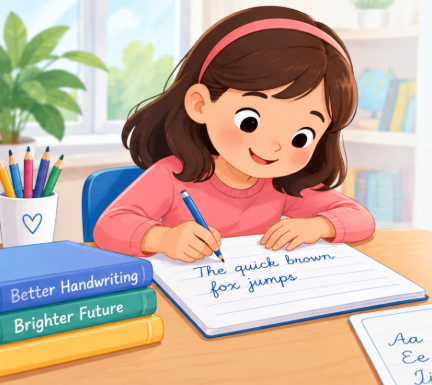
Cursive writing is important for children because it helps develop handwriting fluency, fine-motor coordination, letter recognition, and focused writing practice. Learning the cursive alphabet also teaches children how individual letters connect to form words, which can make handwriting smoother and more natural. Beyond neat penmanship, cursive gives children another way to practice literacy skills and recognize different forms of handwritten text.
Table of Contents
What Is Cursive Writing?
Cursive writing is a style of handwriting in which letters are commonly connected within words. Instead of stopping after forming every individual letter, children learn to move the pencil smoothly from one letter to the next. For example, a child learning the word “cat” in print may form three separate letters. In cursive, the child practices the movements needed to connect c, a, and t into one flowing word. The cursive alphabet includes 26 uppercase and 26 lowercase letters, although the exact appearance of some letters can vary between handwriting styles and teaching systems. Learning cursive is therefore more than memorizing how letters look. Children also learn where to begin a letter, how to move the pencil, where to finish, and how to connect that letter with others.
Why Is Cursive Writing Important for Children?
Cursive writing can provide several useful learning experiences. learning cursive value isn’t simply that it makes handwriting look attractive. The process of forming and connecting letters requires children to coordinate what they see with controlled hand movements.
1. It Develops Fine-Motor Skills
Writing requires small, controlled movements of the fingers, hand, and wrist. Cursive gives children repeated opportunities to practice these movements. When a child traces a curve, forms a loop, or connects two letters, they are practicing pencil control and coordination. For example, a child learning a cursive “l” may repeatedly practice its tall loop before using it in words such as “light” or “love.” Over time, these movements become more familiar. Cursive should not be treated as a medical solution for fine-motor difficulties, but regular handwriting practice can provide useful opportunities to develop controlled hand movements.
2. It Helps Build Handwriting Fluency
Fluent handwriting allows children to focus more on what they want to write instead of thinking about every individual letter.
At first, a child may write slowly:
c → a → t
With practice, those separate decisions become a smoother movement:
cat
The goal isn’t simply to make children write faster. Good handwriting also involves readable letters, appropriate spacing, consistent size, and comfortable movement.
3. It Strengthens Hand-Eye Coordination
Children have to look at a letter, remember its shape, plan the movement, and guide the pencil across the page. This combination of visual attention and physical movement makes handwriting an active learning task. A simple activity demonstrates this well: ask a child to copy a cursive word such as “sunshine.” They need to observe the model, reproduce each letter, maintain the correct direction, and keep the word aligned with the writing line.
4. It Gives Children More Practice With Letters and Words
Learning the cursive alphabet gives children another opportunity to study letter shapes. They may already recognize a printed “A,” but seeing and writing a cursive “A” introduces another visual form to understand. This can be especially useful when children encounter handwritten notes, cards, signs, older documents, or another person’s handwriting. Cursive isn’t a replacement for print-letter instruction. Instead, it gives children another handwriting system to recognize and use.
5. It Can Support Literacy Development
Handwriting and literacy are closely connected learning activities. When children write letters and words, they repeatedly think about letter shapes, sounds, spelling, and word structure. Research on handwriting instruction has reported connections between handwriting practice and aspects of children’s writing and reading development. However, it’s better to view cursive as one part of a broader literacy program rather than claiming that cursive alone guarantees better reading. For example, when a child writes “The dog is running,” they practice letter formation while also thinking about spelling, word order, sentence structure, and meaning.
6. It Encourages Focus and Careful Practice
Cursive requires children to pay attention to movement, spacing, letter size, and connections.
A short practice session can become a focused activity when children have a clear goal.
Instead of asking a child to fill an entire page with the same letter, try a smaller challenge:
“Let’s practice five good lowercase g’s, then use three of them in words.”
This approach makes the task feel achievable while still providing repetition.
7. It Supports Learning Through Active Writing
Writing by hand gives children an opportunity to physically interact with the information they are learning. For instance, a child studying vocabulary might write each new word in cursive and then use it in a sentence. The activity combines spelling, handwriting, and meaning instead of relying only on reading the words from a screen. This doesn’t mean cursive automatically improves memory or makes children learn better than typing in every situation. It simply provides another active way to engage with written information.
8. It Can Build Writing Confidence
Children often feel proud when they notice that their handwriting is becoming smoother and more consistent. A child who initially struggles to connect two letters may eventually write an entire name or sentence independently. That small achievement can make handwriting feel less intimidating. The best approach is to praise progress rather than demand perfection. Saying “Your letters are much more consistent now” gives children a specific improvement to feel good about.
9. It Helps Children Read Different Forms of Handwriting
Learning cursive isn’t only about producing cursive. Children also need to recognize it when someone else uses it. Being familiar with cursive can help children read handwritten notes, cards, letters, family keepsakes, and other forms of handwriting. That gives cursive a practical purpose beyond classroom worksheets.
How Does the Cursive Alphabet Help Children Learn?
The cursive alphabet gives children a foundation for understanding how individual letters are formed and connected. Rather than expecting children to master all 26 letters immediately, parents and teachers can introduce letters gradually. Similar movement patterns can also be practiced together. For example, children can work on letters involving similar curves or loops before moving to more complicated forms. Once individual letters become familiar, the progression can look like this:
Letters → letter pairs → words → sentences → short paragraphs
A child might begin by practicing a, then an, then and, and eventually write a sentence such as:
“An ant is on the leaf.”
This gradual progression gives children a clear reason for learning each letter.
What Age Should Children Learn Cursive Writing?
There isn’t one perfect age for every child. Readiness depends on the child’s handwriting experience, fine-motor control, school curriculum, and confidence. Many children encounter cursive during the early elementary years, after they have developed familiarity with basic letter shapes and pencil control. Signs that a child may be ready include being able to hold and control a pencil comfortably, recognize common letters, copy simple shapes or words, and follow basic writing instructions. The important thing is to match the activity to the child’s current skills rather than turning a specific age into a deadline.
How to Teach the Cursive Alphabet to Children
- A simple teaching sequence can make cursive much less overwhelming.
- Start with basic strokes. Practice curves, loops, lines, and other movements used to form letters.
- Introduce lowercase letters. These appear frequently in everyday writing, so children get plenty of opportunities to use them.
- Group letters by movement. Practicing letters with similar strokes can help children recognize recurring patterns.
- Practice connections. Move from individual letters to simple combinations such as la, le, li, and lo.
- Write familiar words. Children’s names, family words, animals, and favorite foods can make practice more meaningful.
- Introduce uppercase letters. Once children are comfortable with basic lowercase movements, they can begin practicing capital cursive forms.
- Move to sentences. Short sentences give children a chance to combine everything they’ve learned.
- Correct formation should come before speed. A neat, comfortable word written slowly is a better starting point than rushed handwriting that creates frustration.
What If a Child Struggles With Cursive?
Some children find particular letters or connections difficult. That’s normal during the learning process. Look for the specific problem rather than correcting everything at once. If a child struggles with letter size, practice writing between two lines. If connections are difficult, isolate two-letter combinations before returning to complete words. If the child becomes tired quickly, use shorter practice sessions. Encouragement also matters. Instead of saying “Your handwriting is messy,” try “Your letters are getting more consistent. Let’s work on the spacing next. ”If handwriting difficulties are persistent or significantly interfere with schoolwork, parents can discuss them with the child’s teacher and, when appropriate, seek advice from a qualified professional.
Cursive Writing vs. Print Writing
Print and cursive serve different purposes, and children can benefit from learning both. Print writing usually presents letters separately, making individual letter shapes easy to identify. Cursive adds connected movements and another way of forming and recognizing letters. Think of them as two handwriting tools rather than competitors. A child might use print when learning basic letter formation and later develop cursive for fluent handwriting. Being familiar with both styles can also make it easier to read different kinds of handwritten material.
Cursive Writing in the Digital Age
Children don’t have to choose between technology and handwriting. Computers, tablets, keyboards, and other digital tools are part of modern learning. At the same time, handwriting remains useful for classroom notes, personal writing, creative activities, and everyday communication. A child might spend an hour working on a computer and then write a short journal entry by hand. These activities can complement rather than compete with each other.
Do Children Still Need to Learn Cursive?
For many children, cursive remains a useful skill, but it doesn’t need to be treated as the only correct form of handwriting. Children benefit from learning basic handwriting, developing digital skills, and becoming comfortable reading different forms of written communication. Cursive writing can be especially useful when children encounter handwritten material or want to use handwriting for personal, academic, or creative purposes. The most practical approach is to teach cursive as one useful part of a larger literacy and communication toolkit.
Tips for Parents and Teachers
- Keep cursive practice short and consistent. Demonstrate a letter before asking children to copy it, and focus on one improvement at a time.
- Use meaningful words whenever possible. A child who loves animals might practice cat, dog, horse, and rabbit instead of a random list of words.
- Praise progress rather than demanding perfection. If a child has improved the shape of a difficult letter, recognize that improvement.
- Most importantly, give children opportunities to use their handwriting for real purposes. When writing has a purpose, practice feels less like a chore.
Final Thoughts
Cursive writing is more than a traditional handwriting style. For children, learning the cursive alphabet can provide practice with controlled hand movements, letter formation, handwriting fluency, and visual attention. Its greatest value comes when it is taught as part of a broader approach to literacy rather than as a skill children must master perfectly. Start with simple strokes, introduce letters gradually, connect them into words, and give children enjoyable reasons to write. With patient practice, cursive can become a useful handwriting skill that children carry into their schoolwork and everyday lives.
Frequently Asked Questions
Is cursive writing good for children?
Cursive writing can give children useful practice with controlled hand movements, letter formation, handwriting fluency, visual attention, and recognizing different forms of handwriting.
What age should children learn cursive?
There is no universal age. Many children encounter cursive during the early elementary years, but readiness depends on their existing handwriting and pencil-control skills.
Does cursive help children read?
Cursive writing gives children additional practice recognizing letter shapes and can help them become familiar with handwritten text. It should be considered part of broader reading and literacy instruction.
Is cursive better than print?
Neither is universally “better.” Print and cursive writing have different characteristics, and children can benefit from learning and recognizing both.
Does cursive improve handwriting?
Cursive practice can help children develop smoother letter movements and greater consistency. Results depend on regular practice, instruction, and the child’s individual skills.
How can parents practice cursive at home?
Keep sessions short and enjoyable. Practice basic strokes, letters, connections, and familiar words, then gradually move toward sentences and short writing activities.