Cursive writing connects letters, while print writing usually keeps letters separate. Print uses individual letter shapes that are easy to recognize, while cursive uses flowing strokes to join letters within a word. For example, “cat” is written as three separate letters in print, while the letters flow together in cursive. The two styles differ in letter formation, pen movement, spacing, writing speed, and readability.
Neither style is always better. Print is often easier for children who are learning basic letters, while cursive can help children practice smooth letter connections and flowing handwriting. Your choice can depend on your age, writing habits, schoolwork, and what feels comfortable.
What Is Print Writing?
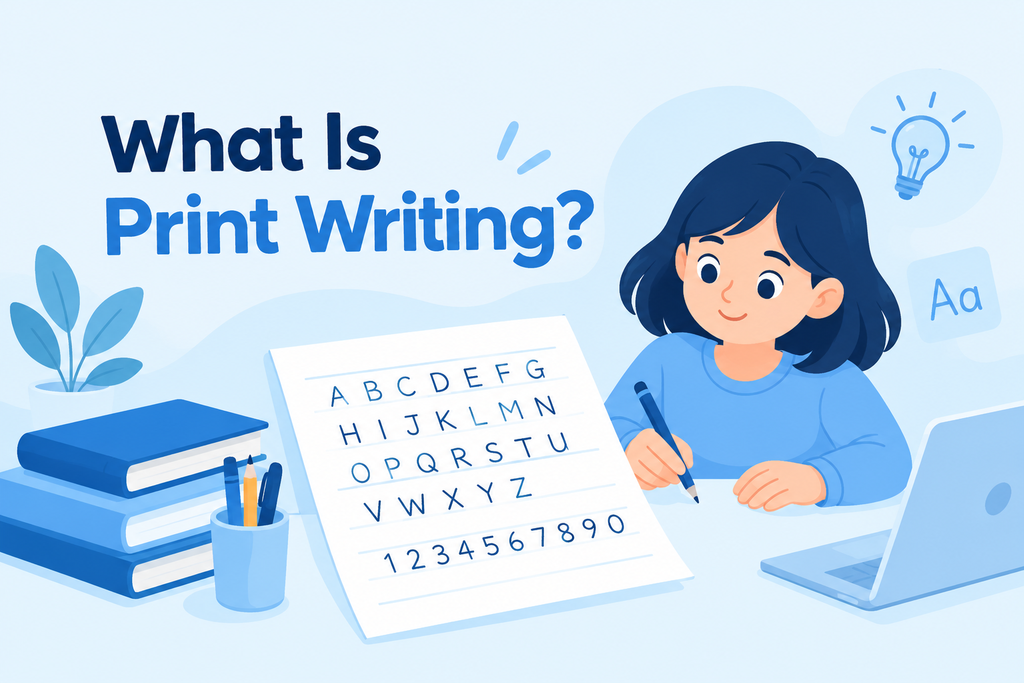
Print writing is a style of handwriting where letters are written separately. The letters usually look similar to the ones children see in books, school worksheets, signs, and on screens.
For example, you might write:
cat
Each letter is formed on its own. You finish the c, then write the a, and then the t.
Print is often one of the first handwriting styles children learn. It gives them a chance to practice letter formation, learn uppercase and lowercase letters, and understand how letters fit together to make words.
Print handwriting does not have to look exactly like a computer font. As children practice, their letters will naturally develop their own shape and style. The most important things are clear letters, good spacing, and comfortable writing.
Children who are learning the alphabet can start by practicing individual letters before moving on to complete words. The cursive alphabet can also help when they are ready to learn a different handwriting style.
What Is Cursive Writing?
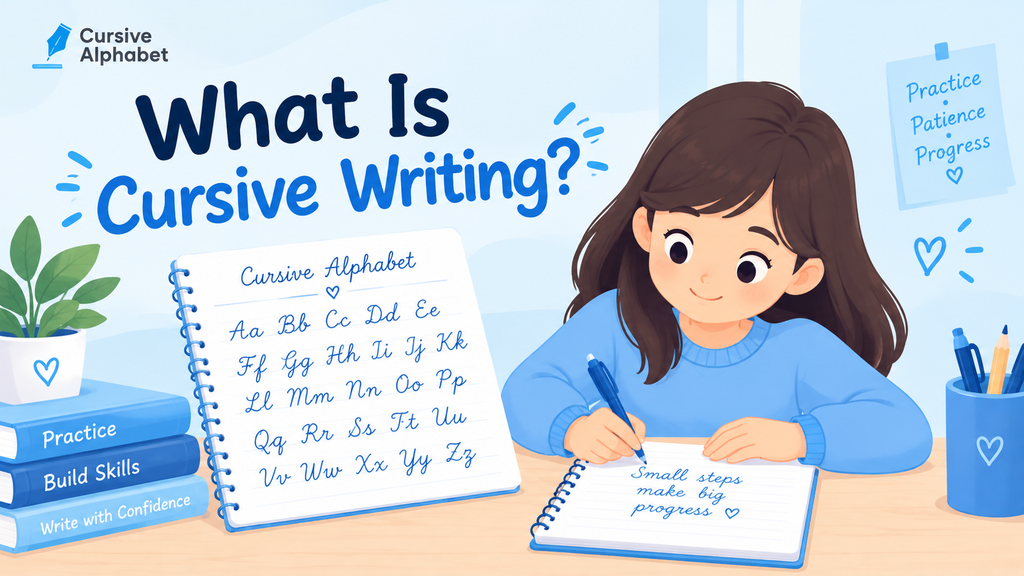
Cursive writing is a handwriting style where many letters are joined together. Instead of stopping after every letter, your hand moves smoothly from one letter to the next.
For example, when writing the word “cat” in cursive, the c, a, and t can be connected through flowing strokes.
Cursive letters can also look different from print letters. Some letters have new shapes, while others use different starting and ending strokes.
Children usually learn cursive by practicing one letter at a time. After that, they can practice joining letters, writing words, and forming complete sentences.
If you are learning cursive, start with individual uppercase and lowercase letters. The cursive alphabet A to Z gives beginners a simple place to practice each letter before moving on to connected writing.
Cursive Writing vs. Print Writing: Key Differences
The biggest difference is how the letters are formed and how your hand moves across the page.
| Feature | Cursive Writing | Print Writing |
| Letters | Usually connected | Usually separate |
| Pen movement | Smooth and flowing | More individual movements |
| Pen lifts | Often fewer | Often more |
| Letter shapes | Some shapes are different | Usually familiar shapes |
| Slant | Often slightly slanted | Often more upright |
| Learning | Needs practice with joins | Often easier to start with |
| Speed | Can become fast with practice | Can also become fast with practice |
| Reading | Can be easy to read when neat | Often easy to recognize |
| Style | Can become very personal | Can also develop a personal style |
These differences do not mean that one style is always better. A child may find print easier at first and enjoy cursive later. Another child may quickly become comfortable with connected writing.
Practice plays a big part in both styles.
How Are Cursive and Print Letters Different?
The letters themselves can look different.
In print, a lowercase a is usually written as a familiar separate shape. In cursive, the same letter may have a different shape and connecting strokes that help it join the next letter.
The same thing happens with letters such as b, f, r, s, and z. Some cursive forms are easy to recognize after practice, while others may look quite different from their printed versions.
Cursive also gives each letter a beginning and ending movement. The ending of one letter can lead directly into the next letter.
That is why learning cursive is more than simply drawing a line between print letters. Children need to learn where to start a letter, how to move the pencil, and how to connect it to the next letter.
You can practice these movements through cursive joining letters. Learning common letter connections can make word writing feel much easier.
Is Cursive Faster Than Print?
Cursive can become faster because the letters are connected and the hand can keep moving through a word.
Imagine writing a long sentence by hand. In print, you may lift your pencil or pen several times while forming each letter. In cursive, many letters can be written in one smooth movement.
However, cursive is not automatically faster for everyone.
A child who has practiced print handwriting for years may write print much faster than a beginner who has just started learning cursive. Speed improves when the writer becomes comfortable with the letter shapes and connections.
The best way to improve handwriting speed is to practice slowly and correctly first. Once the movements become familiar, writing can naturally become quicker.
Which Is Easier to Read: Cursive or Print?
Print can be easier for someone who is not used to reading cursive because each letter is clearly separated.
For example, a printed sentence gives the reader clear spaces between individual letters. Cursive connects letters, so the reader needs to recognize the shapes and joins as a group.
Neat cursive can still be very easy to read. Good spacing, clear letters, and consistent writing make a big difference.
Think about two examples:
Neat print:
The quick brown fox jumps over the dog.
Neat cursive:
The same sentence can be easy to read when the letters and spaces are clear.
Messy handwriting can be difficult to read in either style. Clear letter formation and good spacing matter more than simply choosing cursive or print.
Should Children Learn Print or Cursive First?
Many children start with print handwriting because they see printed letters everywhere. Books, worksheets, classroom posters, signs, and many digital screens use familiar print letterforms.
Learning print also gives children time to practice basic letter formation and pencil control. They can learn how each uppercase and lowercase letter looks before learning how letters connect.
Cursive can come later as children become more comfortable with handwriting. It introduces new letter shapes and movements, so regular practice helps.
There is no single starting age that works perfectly for every child. Schools and teachers may use different handwriting programs, and children also learn at different speeds.
The main goal should be helping children develop clear, comfortable, and confident handwriting.
Cursive vs. Print for Adults
Adults can use either style depending on what they are writing.
Print can be useful for filling out forms, writing labels, or leaving a note that needs to be easy for another person to read.
Cursive can feel natural for personal letters, journaling, signatures, or quick notes. Some adults also learn cursive because they want to improve their handwriting or read old handwritten letters and documents.
Adults do not have to completely change their existing handwriting. They can learn a few cursive letters first and slowly add more connections.
For example, someone might write most letters in print but connect th, ing, or st when writing quickly. This can become a natural handwriting style over time.
Can You Mix Cursive and Print?
Yes. You can mix cursive and print in the same handwriting style.
Many people naturally create a mix of the two. They might use printed capital letters but connect some lowercase letters. Others may write most words in cursive but use print for numbers or certain letters.
This is sometimes called hybrid handwriting.
Imagine taking notes during class. You may start writing neatly in print, then connect letters when you need to write faster. That is a normal way for handwriting to develop.
You do not need to force every letter to look exactly like a handwriting worksheet. The important thing is that your writing feels comfortable and remains easy to read.
Does Cursive Help Children Learn?
Handwriting practice gives children a chance to learn letter shapes while using their hands to form them. Cursive adds connected movements, which can help children practice smooth writing and letter transitions.
However, it is better to avoid saying that cursive is automatically better for learning than print. Different children may find different handwriting styles easier.
A child who struggles with one style may need more practice, a different teaching method, or extra support with pencil control and letter formation.
Cursive can be one useful part of handwriting practice, especially when children already understand basic letter shapes.
When Should You Use Cursive or Print?
The best style can depend on the task.
| Writing Situation | Useful Style |
| Learning basic letters | |
| Practicing alphabet shapes | Print or cursive |
| School worksheets | Usually print |
| Filling out forms | |
| Writing a personal letter | Cursive or print |
| Keeping a journal | Either style |
| Taking quick notes | Cursive or hybrid |
| Writing a signature | Cursive or personal style |
| Practicing handwriting | Both can be useful |
For example, a child may use print for a school worksheet because the teacher needs to read every letter clearly. The same child may use cursive when writing a personal journal entry.
There is no rule saying you must use only one style all the time.
How to Improve Your Cursive or Print Handwriting
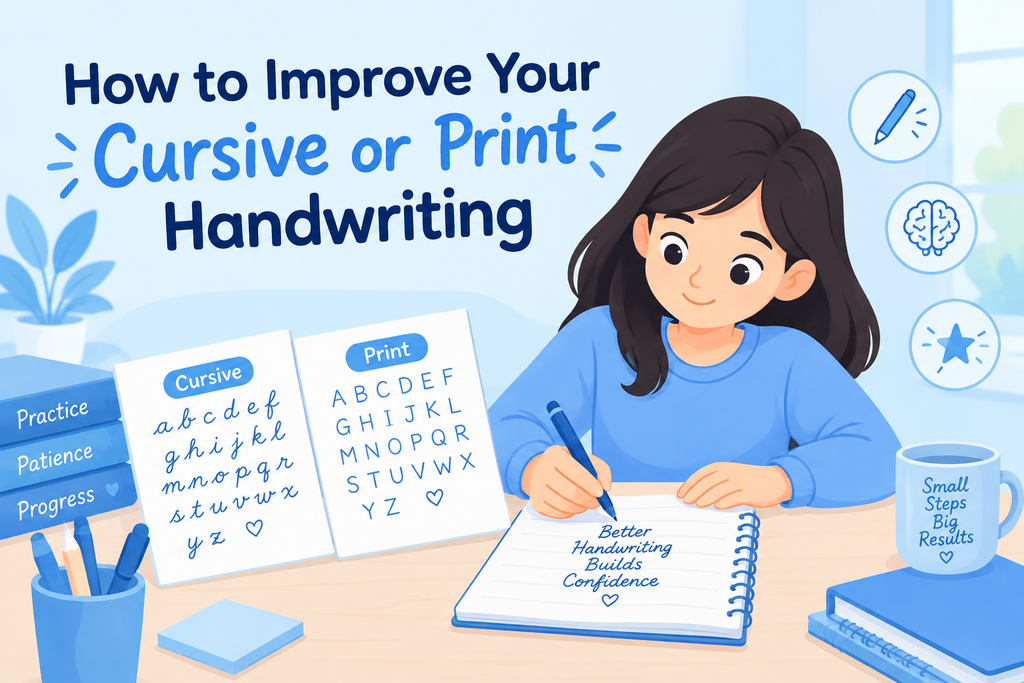
Good handwriting comes from regular practice. You do not need to spend hours writing the same letter.
Start with a few letters and focus on correct letter formation. Make each letter carefully before trying to write quickly.
Next, practice joining letters together. Short combinations such as an, in, on, th, st, and ing are useful for cursive learners because they appear in many everyday words.
Once the connections feel comfortable, practice complete words. Cursive words can help you move from individual letters to real handwriting practice.
After words, start writing short sentences. This helps you practice letter spacing, word spacing, size, and writing flow at the same time. You can use cursive sentences for this stage.
Finally, try short paragraphs. Writing several lines helps you keep your handwriting consistent instead of focusing on just one word at a time. Cursive paragraphs can help you practice longer pieces of handwriting.
A simple practice routine can look like this:
- Practice five letters.
- Write five common letter combinations.
- Copy five words.
- Write two sentences.
- Check your spacing and letter shapes.
Start slowly. Once the movements become familiar, your handwriting will usually feel more natural.
Cursive Writing vs. Print Writing: Which One Should You Choose?
Cursive and print writing both have a place in handwriting practice.
Print writing keeps letters separate, which can make it easier for beginners to learn basic letter shapes and for readers to recognize individual letters.
Cursive writing connects letters, which creates a flowing movement and can become comfortable for people who practice it regularly.
You can also use both styles. Print may work better for a school worksheet or form, while cursive or hybrid handwriting may feel better for a personal letter or quick notes.
The most useful handwriting style is one that you can write comfortably, form clearly, and read easily. If you are learning cursive, start with the cursive alphabet, then practice joins, words, sentences, and paragraphs as your skills improve.
Frequently Asked Questions
What is the difference between cursive and print writing?
Cursive writing connects many letters within a word, while print writing usually keeps letters separate. Cursive uses more flowing pen movements, while print focuses on individual letter shapes.
Is cursive faster than print?
Cursive can become faster because letters are connected, but speed depends on practice. A skilled print writer can also write very quickly.
Is print easier to read than cursive?
Print can be easier for beginners and unfamiliar readers because the letters are separate. Neat cursive can also be easy to read when the letters and spacing are clear.
Should children learn cursive or print first?
Many children begin with print because they see printed letters often in books and school materials. Cursive can be introduced later as another handwriting skill.
Can you mix cursive and print?
Yes. Many people naturally use a combination of cursive and print. This is often called hybrid handwriting.
Can adults learn cursive?
Yes. Adults can learn cursive at any age. Start with individual letters, then practice joins, words, sentences, and longer passages.
How can I improve my cursive handwriting?
Practice letter formation first, then move to letter joins, words, sentences, and paragraphs. Regular short practice can help improve control, spacing, and writing flow.