
Cursive J
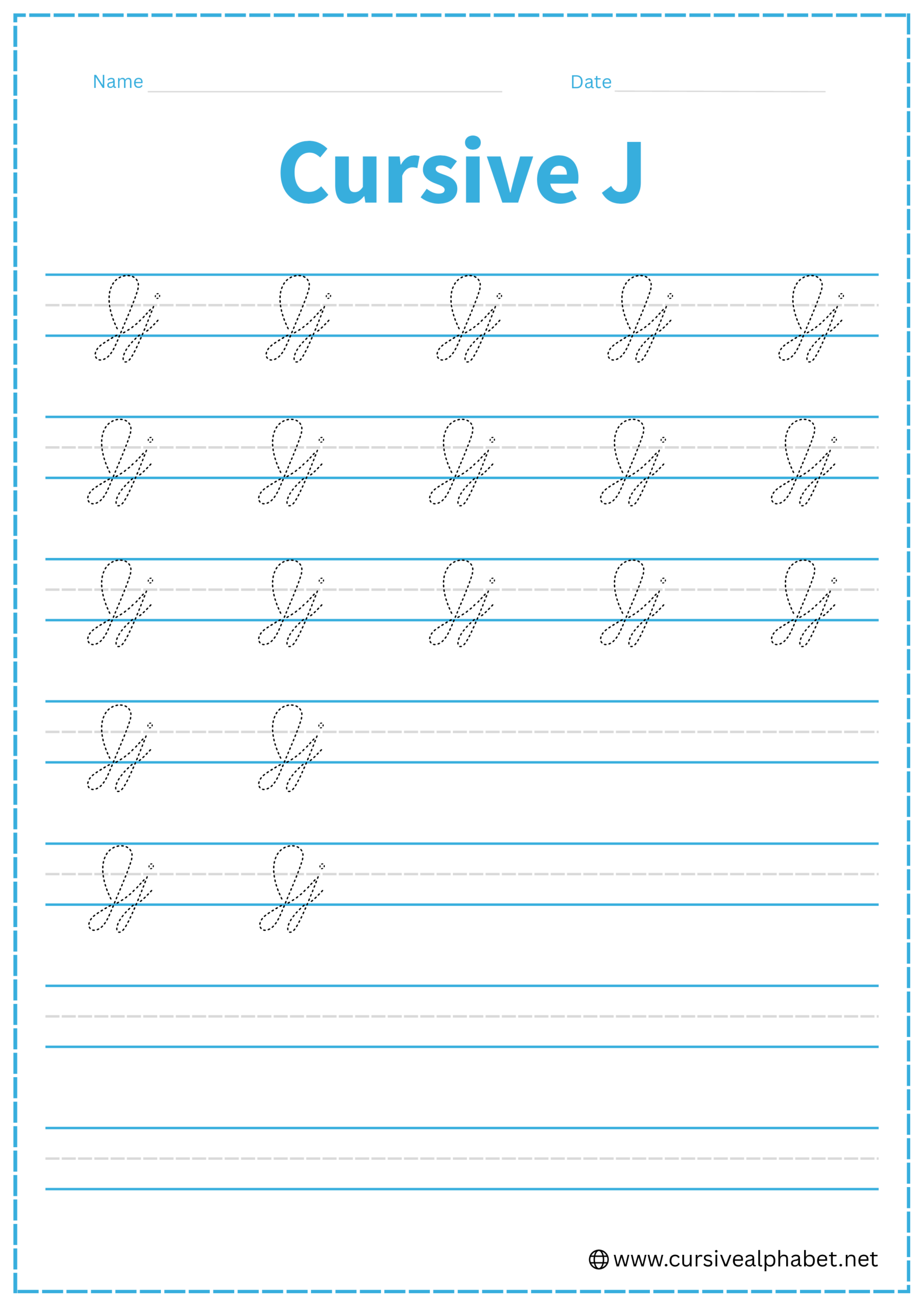
Cursive J is a unique letter with a smooth curve and a tail below the baseline. Learn how to write uppercase and lowercase J and practice with free printable worksheets.
How to Write J in Cursive
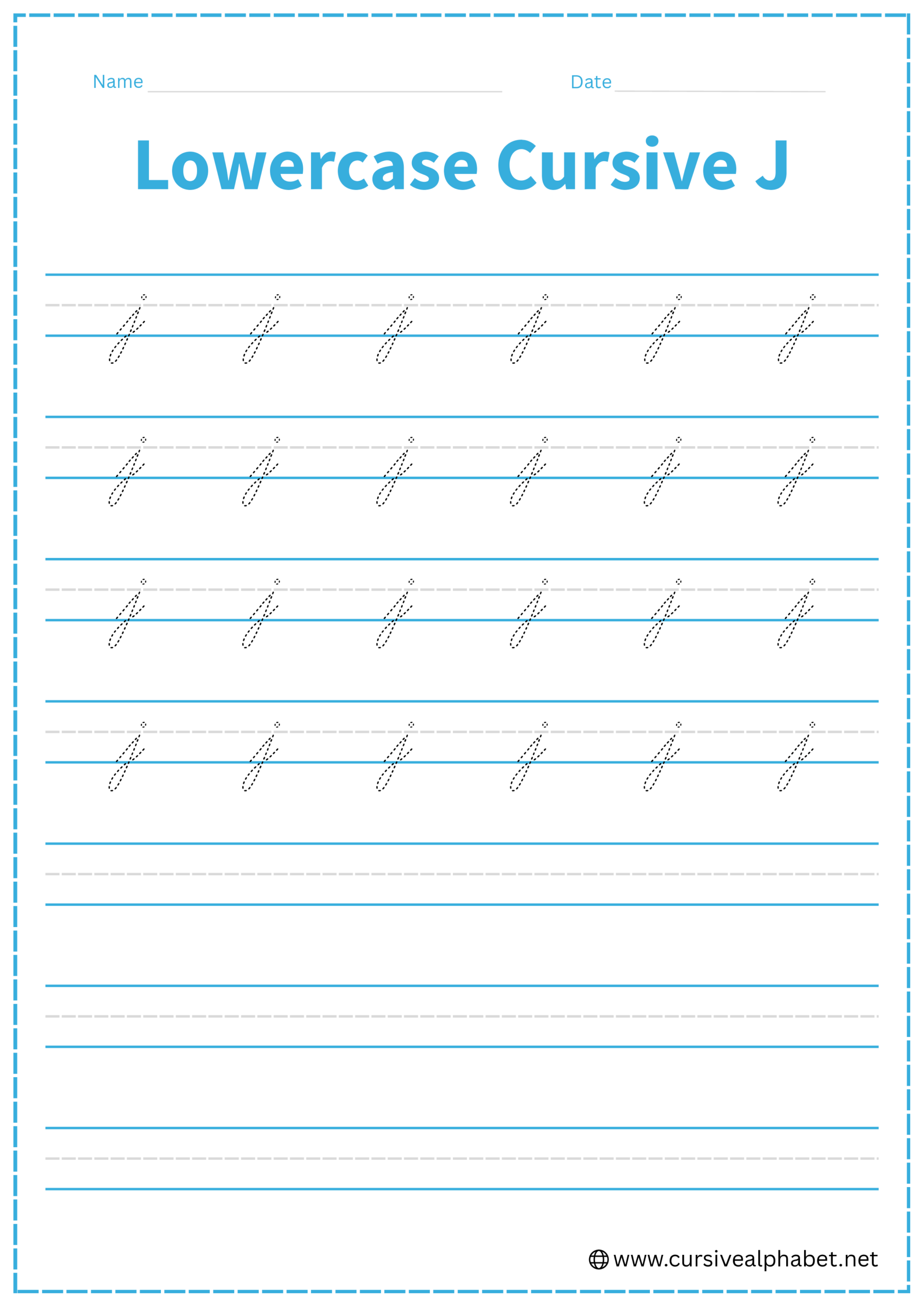
Writing a cursive j is very similar to writing an i, but with a “tail” that dives below the line. It is one of the few lowercase letters that uses both a dot and a descending loop.
How to Write Lowercase Cursive J
- Start on the bottom baseline and curve upward to the middle dashed line (exactly like a lowercase i).
- Instead of stopping at the baseline, draw a straight line down through the paper, past the bottom baseline.
- Once you are below the baseline, curve to the left to create a slender loop.
- Bring the stroke back up and cross the vertical line exactly at the bottom baseline.
- Finish with a flick toward the middle dashed line to connect to the next letter.
- Lift your pen and place a clean dot centered above the middle dashed line.
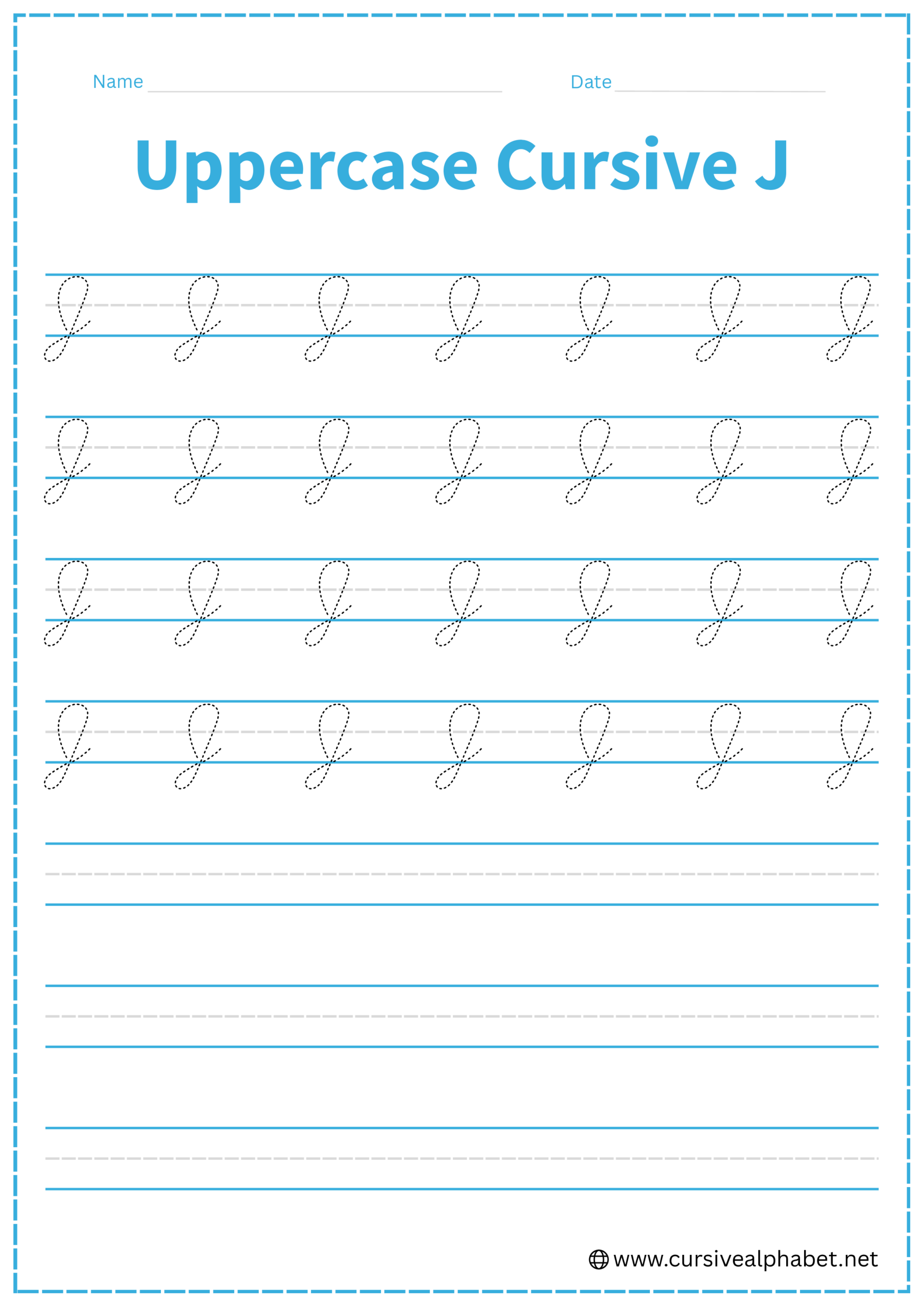
How to Write Uppercase Cursive J
- Start just below the middle dashed line, curve up to the top line, and then back down.
- Draw a long, slightly slanted line all the way from the top line, past the bottom baseline, and into the space below.
- Just like the lowercase version, curve to the left and sweep back up.
- Cross the main stem at the bottom baseline and flick to the right to connect to the next letter.
Common Mistakes to Avoid
Lowercase Cursive J
- Looping to the right at the bottom instead of the left.
- Crossing the loop too high (above the baseline) or too low.
- Forgetting the dot, which can make it look like part of a different letter (like a g or y).
Uppercase Cursive J
- Confusing it with an “I”: Remember that J always goes below the bottom line, while I stays above it.
- Making the top too narrow: The top of the J should be wide and rounded.
Frequently Asked Questions
Yes. Both the uppercase and lowercase cursive J are “descending” letters. This means the tail must cross the bottom baseline and loop in the space below. If the letter stays above the baseline, it may be mistaken for a cursive I or a lowercase i.
The primary difference is the tail. While a cursive I sits on the bottom baseline, a cursive J dives below it to create a loop. Additionally, the lowercase j requires a dot at the top, whereas the uppercase J does not.
This usually happens because of the direction of the bottom loop. In cursive, the letters j, g, and y all loop to the left. If you accidentally loop to the right, the letter will look distorted or like a different character entirely. Always ensure your pen curves toward the left before crossing back over the main stem.
For a clean and legible look, the loop should cross the vertical stem exactly at the bottom baseline. Crossing too high (above the line) or too low (deep in the margin) can make the handwriting look messy or inconsistent.
Yes. Cursive is known for continuous movement, but “i” and “j” are exceptions. Complete the entire letter, including the tail and the exit stroke, before lifting your pen to place a small, clear dot centered above the middle dashed line.
Both uppercase and lowercase J end with an exit stroke (or “flick”) that moves upward from the baseline toward the middle line. This stroke acts as a bridge, allowing you to move directly into the first stroke of the following letter without stopping.