
Cursive F
Cursive F is an important step to improving your handwriting. On this page, you’ll find clear, step-by-step instructions for writing both uppercase and lowercase F. Download free worksheets to practice tracing and writing the letter F, helping you create smooth, flowing, and neat handwriting.
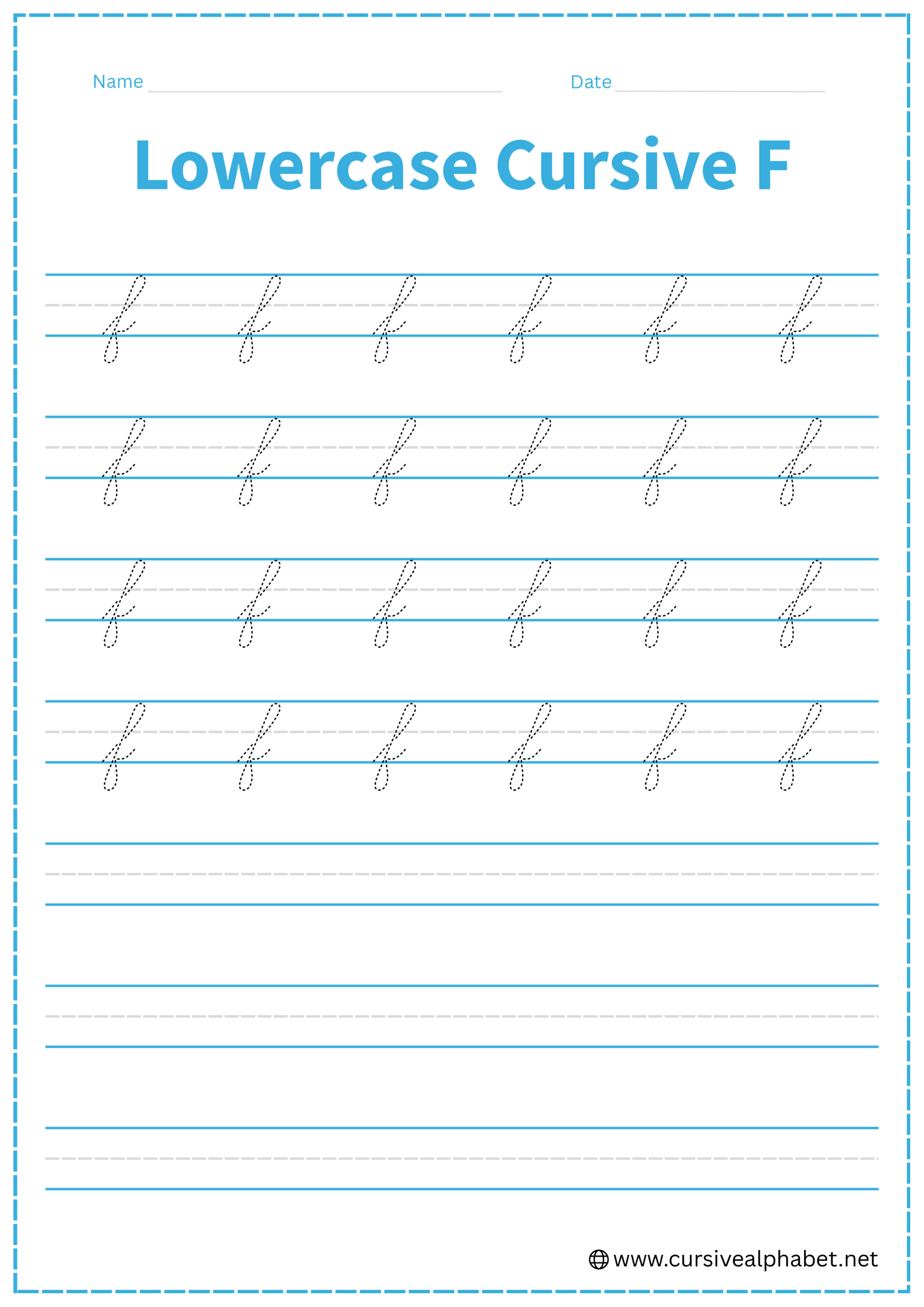
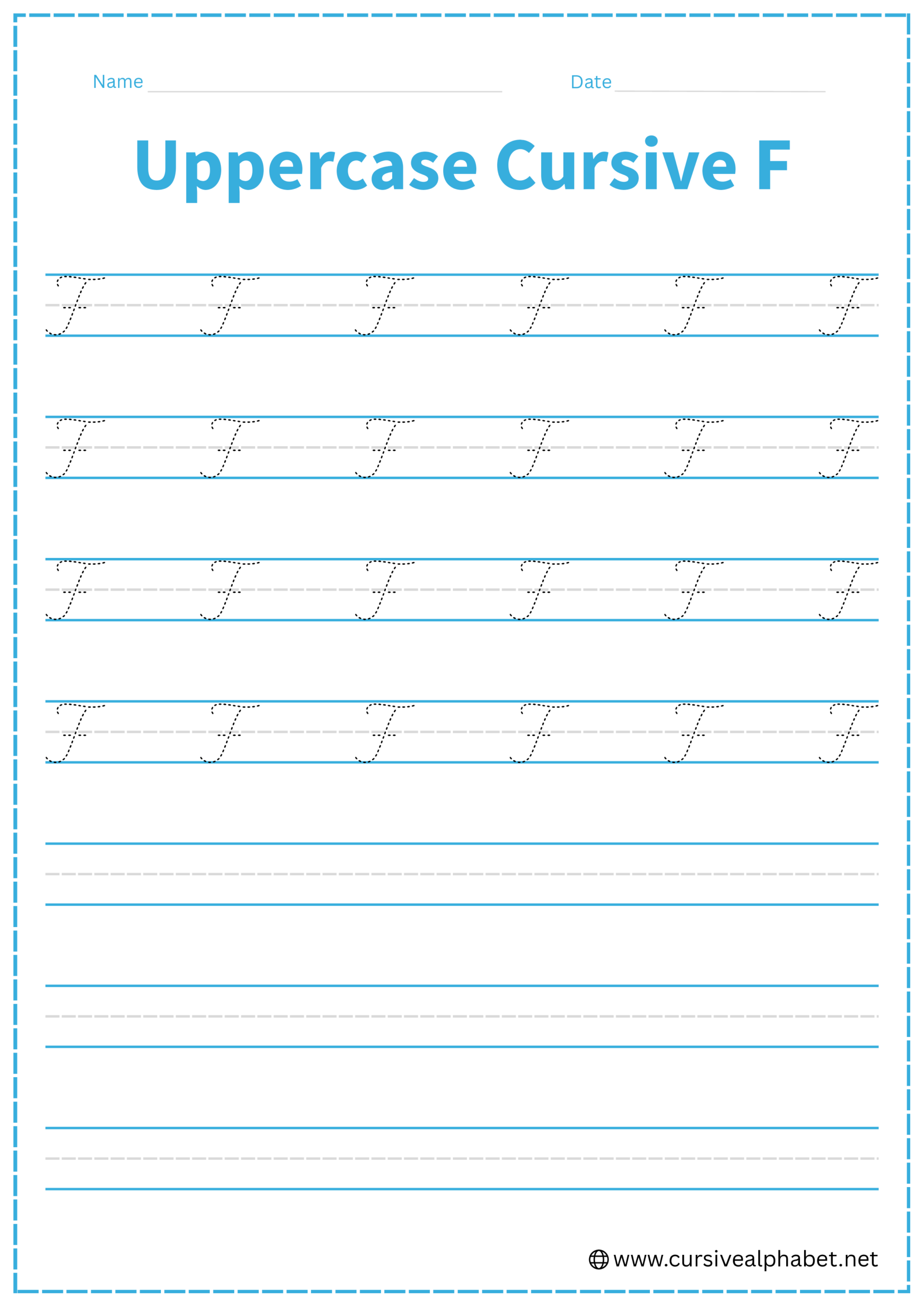
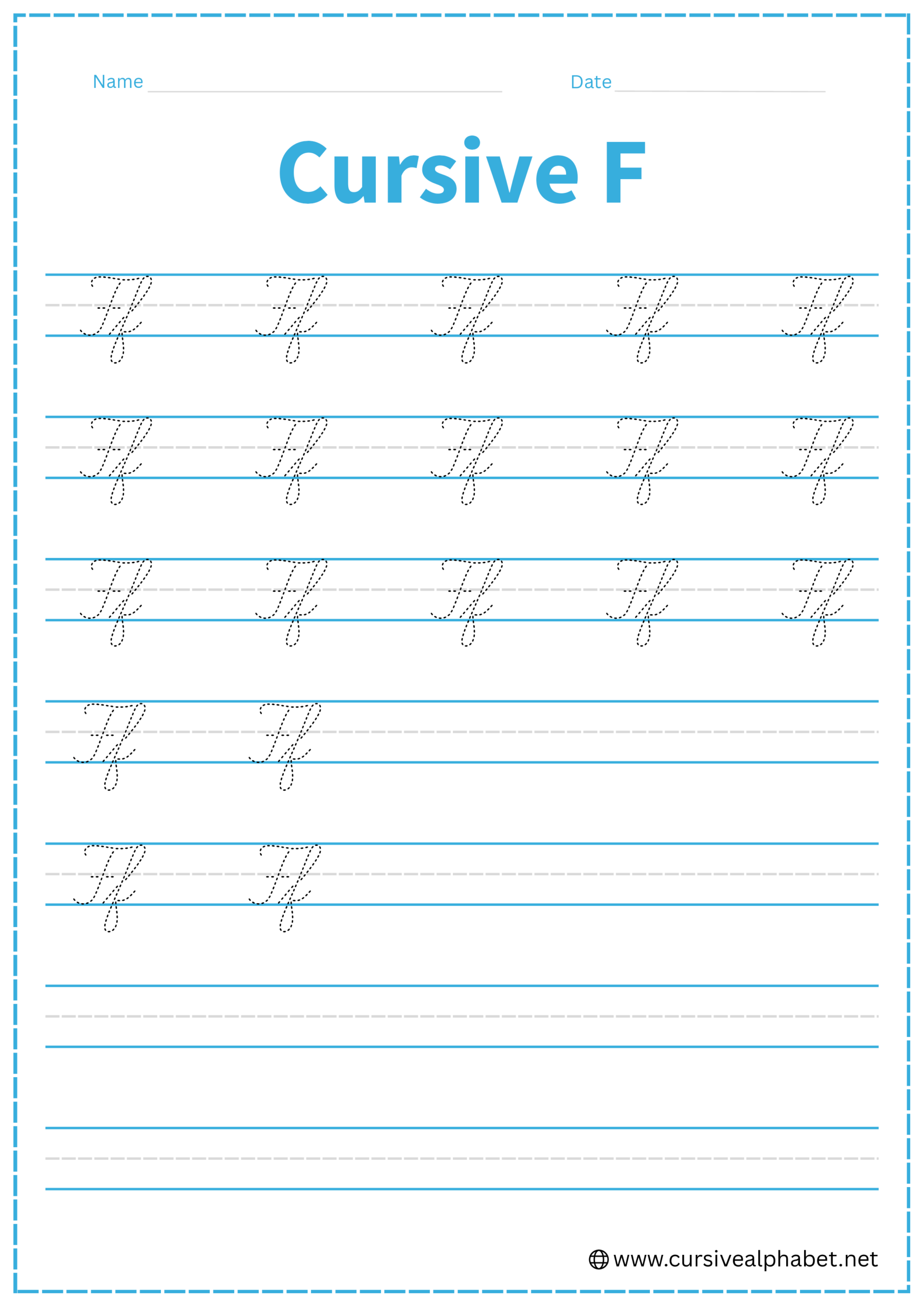
How to Write F in Cursive
The letter f is unique in cursive because it is often the only letter that spans the entire height of the three-lined paper, reaching both the very top and the very bottom.
How to Write Lowercase Cursive F
- Start at the bottom baseline and sweep up at a slant all the way to the top line.
- Curve to the left and head straight down, passing through the middle dashed line and the bottom baseline.
- Continue the line down to the bottom plumbing line (the space below the baseline).
- Curve to the right and head back up toward the bottom baseline.
- Close the loop exactly at the bottom baseline and flick a small connector stroke out toward the middle dashed line.
How to Write Uppercase Cursive F
- Start just below the top line, make a small upward tick, and draw a horizontal “wave” across the top.
- From the center of the wave, draw a slanted line down to the bottom baseline, finishing with a small curl to the left.
- Lift your pen and draw a short horizontal dash exactly on the middle dashed line.
Common Mistakes to Avoid
Lowercase Cursive F
- Looping the bottom to the left instead of the right.
- Stopping at the baseline instead of diving below it.
- Making the top and bottom loops uneven rather than balanced and slender.
Uppercase Cursive F
- Connecting the stem to the top wave too rigidly; it should look like a separate, elegant stroke.
- Forgetting the middle crossbar, which makes it look like a cursive T.
- Curling the bottom tail too far up can clutter the letter.
Frequently Asked Questions
The lowercase f is unique because it is the only letter in the standard cursive alphabet that occupies all three zones of the writing line. It reaches the top line (ascender), sits on the baseline, and dives below into the descender space (the “basement” or plumbing line).
The most common reason is a missing crossbar. In cursive, the uppercase F and T are nearly identical, but the F features a small horizontal dash across the middle of the stem. Without that crossbar, your readers will likely misinterpret the letter as a T.
In standard American cursive (like the Zaner-Bloser or D’Nealian styles), the bottom loop should always curve to the right. Curving to the left is a common mistake that can make the letter look like a messy “b” or “l” and disrupts the flow of the next connector stroke.
For the lowercase f, the connection begins at the middle knot. Once you close the bottom loop at the baseline, flick a small “tail” or connector stroke upward toward the middle dashed line. This stroke leads directly into the start of the following letter.
Typically, no. Most cursive styles treat the uppercase F as a non-connecting letter. You finish the stem with a small curl to the left, lift your pen to draw the crossbar, and then start the next lowercase letter separately without a connecting line.
The secret to an elegant f is balance and slant. Ensure your top and bottom loops are roughly the same width and that both loops follow the same diagonal angle. Avoid making the loops too wide; a slender, “skinny” loop usually looks much neater.